
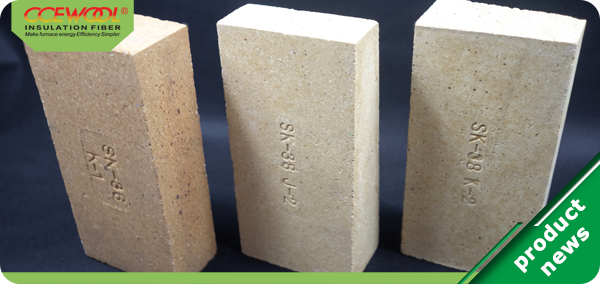
When the temperature of high alumina refractory brick is above 1545℃, with the increase of A12O3 content, the amount of solid phase (mullite or corundum) increases, and the amount of liquid phase that can be generated in the product decreases accordingly. The refractory properties of the product change with the changing of the phase composition in the product, which is due to the high refractory properties of the crystalline phase mullite or corundum. However, when there is a small amount of molten impurities, it will seriously reduce the fire resistance of the product. Because the amount of liquid phase increases, and the temperature at which the liquid phase is formed also decreases. It can be seen that the raw materials for making high-alumina refractory bricks must be pure, otherwise even if the content of A12O3 in the product is increased, good results will not be obtained.
When the A12O3 content in the high alumina refractory brick is less than 72%, before reaching the highest temperature (1870℃), the only stable solid phase is mullite. Except for the SiO2 in the mullite composition, the other SiO2 and molten impurities all form a glassy substance, which is transformed into a liquid phase at high temperature. The liquid phase forms at 1545°C. In fact, due to the action of the molten impurities, the temperature at which the liquid phase is formed is still lower. When the composition of the product is similar to the mullite phase (7l.8% A12O3, 13.2% SiO2), the formation of the liquid phase is reduced, and the fire resistance of the product is also improved. Therefore, the refractory properties of high alumina refractory bricks with A12O3 content less than 72% increase with the increase of mullite content.
Next issue we will continue to introduce the principle of mutual balance of high alumina refractory bricks.

