
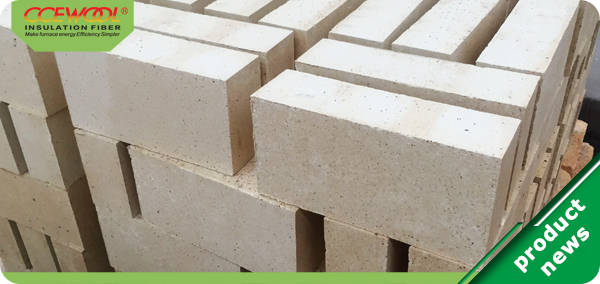
This issue we will continue to introduce the principle of mutual balance of high alumina refractory bricks
For products with Al2O3 content greater than 72%, in the absence of flux, the temperature at which the liquid brush appears is the eutectic temperature of 1850°C in the mullite-corundum system. In fact, since the raw material contains flux substances (usually about 1-3%), the temperature at which the liquid phase is formed is reduced to 1600-1700 °C. At the same time, the softening point under load of the product decreases. Obviously it is much higher than the high alumina refractory products with Al2O3 content less than 72%.
The thermal stability of high alumina refractory brick products depends not only on the structure and particle size of the products. At the same time, due to the different Al2O3 content, the change of the phase composition in the product also affects this property. In products with Al2O3 content less than 72%, with the increase of Al2O3 content, the mullite crystal phase increases, and its thermal stability also increases. When the content of Al2O3 is greater than 72%, the existing crystal phases are mullite and corundum, and the change of thermal stability is another situation. Increasing the Al2O3 content will increase the number of corundum. The thermal expansion coefficient of corundum is larger than that of mullite (the linear expansion rate of corundum is 0.8-0.85% at 1000 ° C; mullite is 0.50-0.557), which promotes the reduction of thermal stability. At the same time, increasing the corundum content will increase the strength and thermal conductivity of the product, and also increase the thermal stability index.
Next issue we will continue to introduce principle of mutual balance of high alumina refractory bricks.

