
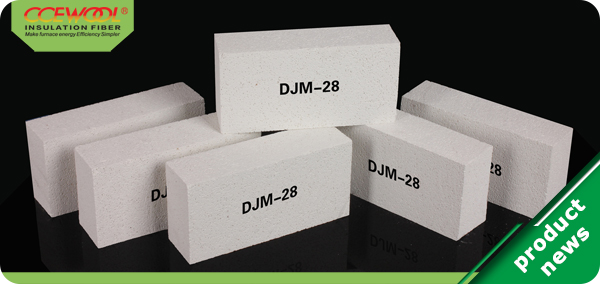
This issue continues to introduce how to improve the thermal insulation performance of mullite insulation bricks.
At high temperature, Fe2O3 has a certain solid solubility in mullite and corundum, forming a limited solid solution. Its solid solubility in corundum is higher than that in mullite. Due to the formation of solid solution, the lattice of mullite and corundum grows. The effect of Fe2O3 on the initial melting temperature of Al2O3-SiO2 series materials is related to the content of Al2O3 in the system or the ratio of Al2O3/SiO2. When Al2O3/SiO2≤2.55, the initial melting temperature is 1380℃, and when Al2O3/SiO2>2.55, the initial melting temperature Raised to 1460 ℃, and gradually increase with the increase of its A12O3 content. Under the reducing atmosphere, Fe2O3 was reduced to FeO and desolubilized into the glass phase, and the initial melting temperature of the system decreased to 1240 °C and 1380 °C, respectively.
In a word, with the increase of Al2O3 content in mullite brick, its high temperature performance improves; while the flux increases, the high temperature performance decreases. Accordingly, strictly controlling the content of impurity oxides, especially the content of K2O, Na2O and Fe2O3, is an important measure to obtain high-performance mullite bricks. When mullite insulation bricks are used in slag or gas environment containing alkali components, it will have a serious erosive effect on mullite bricks.

