
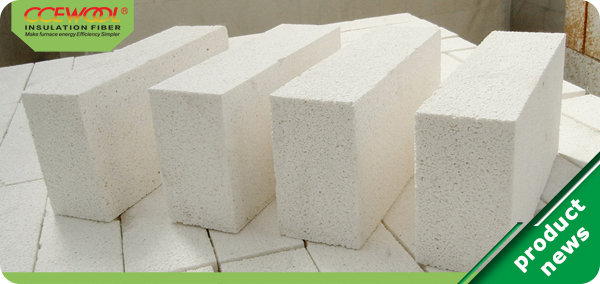
1. The principle of heat insulation of lightweight refractories
Lightweight refractories are heterogeneous multi-phase system materials composed of different kinds of crystal phases, glass phases and gas phases. Therefore, the principle of heat insulation is not only related to the chemical mineral composition of the material, but also related to the crystalline state, microstructure, distribution, content, and arrangement of each phase. Generally, the thermal conductivity of refractory material itself is not necessarily small, but because there are many pores in the light refractory material and filled with gas, and the thermal conductivity of gas is lower than that of any other solid phase, so light refractory material has a very low thermal conductivity.
The heat conduction mode of lightweight refractories still follows the three forms of conduction, convection and radiation and their interaction. Table 1.2 shows the heat transfer ratios of various heat transfer mechanisms in lightweight refractory bricks with a porosity of 70%. It can be seen that even at a high temperature of 1500 degrees Celsius, the heat conduction of solid phase in the lightweight refractory also plays a major role. Therefore, compared with dense refractories, lightweight refractories have a loose porous structure, which can be approximately regarded as the solid phase separated by the gas phase, and the gas plays a good thermal insulation effect in the structure, so the thermal conductivity is very low.
Next issue we will continue to introduce factors that affecting heat insulation of lightweight refractories. Please stay tuned.

