
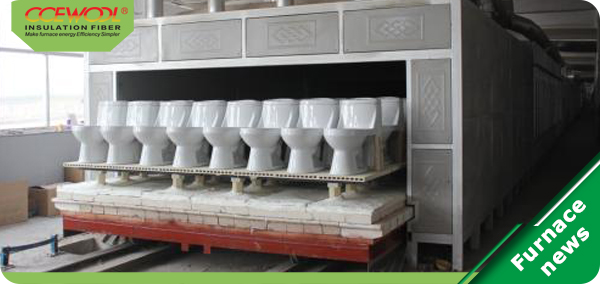
The thermal insulation engineering of the tunnel kiln is a meticulous and cumbersome work. Each part of the construction process can affect the quality of later use. The thermal insulation of the tunnel kiln mainly includes the insulation of the kiln wall, the kiln roof and the pumping waste heat pipe. The kiln wall and kiln roof insulation projects are mainly the construction of lightweight insulation bricks and the laying of insulation layers. The insulation of waste heat pipe is mainly laid with rock wool felt.
Kiln wall insulation
All masonry on both sides of the tunnel kiln requires full mortar, while the internal wall fire bricks and lightweight insulation bricks require less than 3mm mortar joints, plaster fullness should reach 90% or more, and the brick joints must be staggered.
First of all, in terms of fullness of interior wall mortar joints, through multiple tunnel kiln construction inspections, the horizontal joint mortar plumpness can be more than 90%, but some of the vertical joint mortar plumpness does not reach 90%. Even 5 to 8% of the vertical seam appears to have mortar on the surface but there is no mortar in the actual situation. The mortar on the surface of the seam is wiped afterwards. In fact, the vertical seam is an empty seam. When the tunnel kiln is ignited and operated, the refractory bricks and the lightweight thermal insulation brick masonry are positively pressured in the kiln (when the kiln is almost full pressure), the hot air flows out of these gaps into the thermal insulation layers, so that the surface temperature of the outer kiln wall greatly exceeds the design requirements, and a large amount of heat is lost. At the same time, because of the expansion joints on the fire-resistant brick wall with a long parking space, it becomes an independent short wall, and it is easy to incline the wall inwards under the influence of heat flow and affect the life of the tunnel kiln.
Secondly, the design requirements of joints for firebricks and lightweight insulation bricks are less than 3mm, but due to the positive and negative tolerance stipulated in standard, the deviations sometimes exceeding 3mm. Such as ±2, this is greater than 3mm. So the seam can not be controlled to less than 3mm. In order to meet the design requirements, the standard size door is used to separate the same size firebrick or lightweight insulation brick. When building bricks of the same standard size bricks can be built together, making the joints less than 3mm. Otherwise, if the mortar seam is larger than 3mm, dry shrinkage can easily cause gaps in the mortar joints, so that the hot air flow will smash outwards when it is under positive pressure. This not only has a large heat loss but also has an impact on the service life of the kiln.
The design requirement of the mortar joints for external wall bricks is less than 7mm. The mortar of horizontal and vertical joints should also be full. And the brick joint of outer surface of the kiln wall should be applied with cement paste after the kiln is pre heated.
Refractory bricks, insulation layers, thermal insulation bricks, and external wall bricks should be constructed at the same time, and they should be rebuilt step by step from the inside to the outside..
Above is the insulation of the kiln wall. Hope it can bring help to the builders of the kiln. In the next period, we will introduce the insulation of the kiln wall and the laying of the insulation layer. Please stay tuned!

