
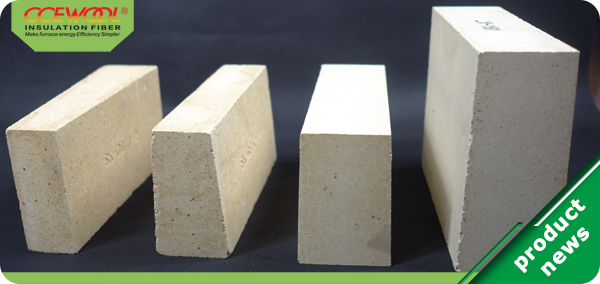
Thermal insulation refractory bricks refer to refractory materials with high porosity, low bulk density and low thermal conductivity. Thermal insulation refractories are also known as lightweight refractories. The following introduces the production process of high-alumina heat-insulating refractory fire bricks.
Due to the high working temperature of high-alumina heat-insulating refractory fire bricks which are 1600℃ and 1500℃ respectively, it can be used both in kiln insulation layer and kiln lining to directly contact the flame. It has good thermal stability and low thermal conductivity. Therefore, the raw material for making high-alumina heat-insulating refractory fire bricks not only has a high content of Al2O3, but also has a low content of impurities, especially Fe2O3, which is easy to melt after heating. At the same time, an appropriate amount of materials that has good properties of withstand abrupt heating and cooling should be added. In order to achieve the low thermal conductivity, the brick must has appropriate bulk density. In order to achieve the required bulk density, corresponding technological measures must be taken. Generally we add the burn lost material.
The raw material composition of the product
The raw material composition of high-alumina heat insulating refractory bricks is high-purity industrial alumina, purified bauxite, mullite concentrate, etc. as the main raw materials. Clay and the like are bounding material, and polystyrene pellets are burn lost material.
Next issue we will continue to introduce production process of high-alumina heat-insulating refractory fire bricks.

